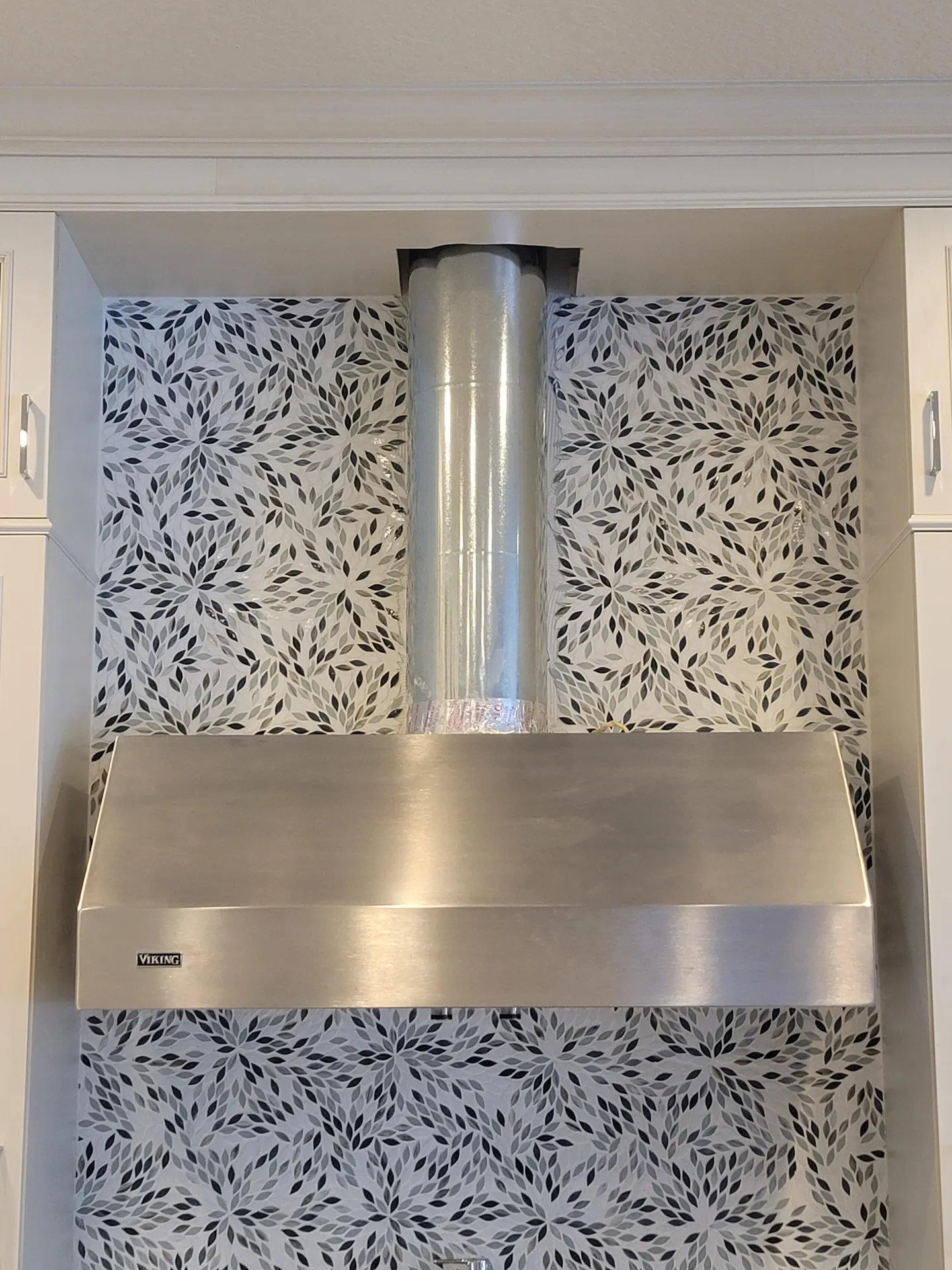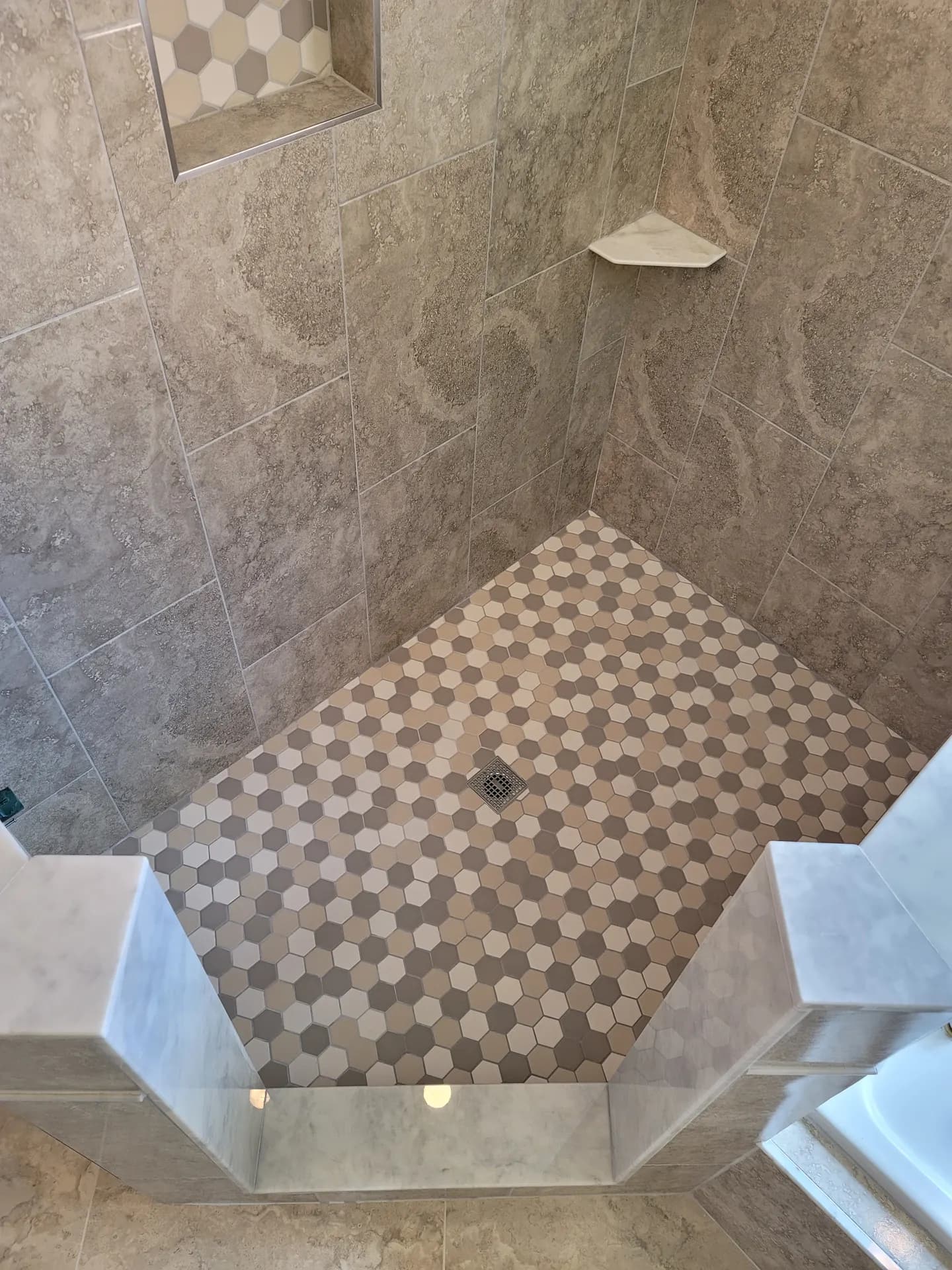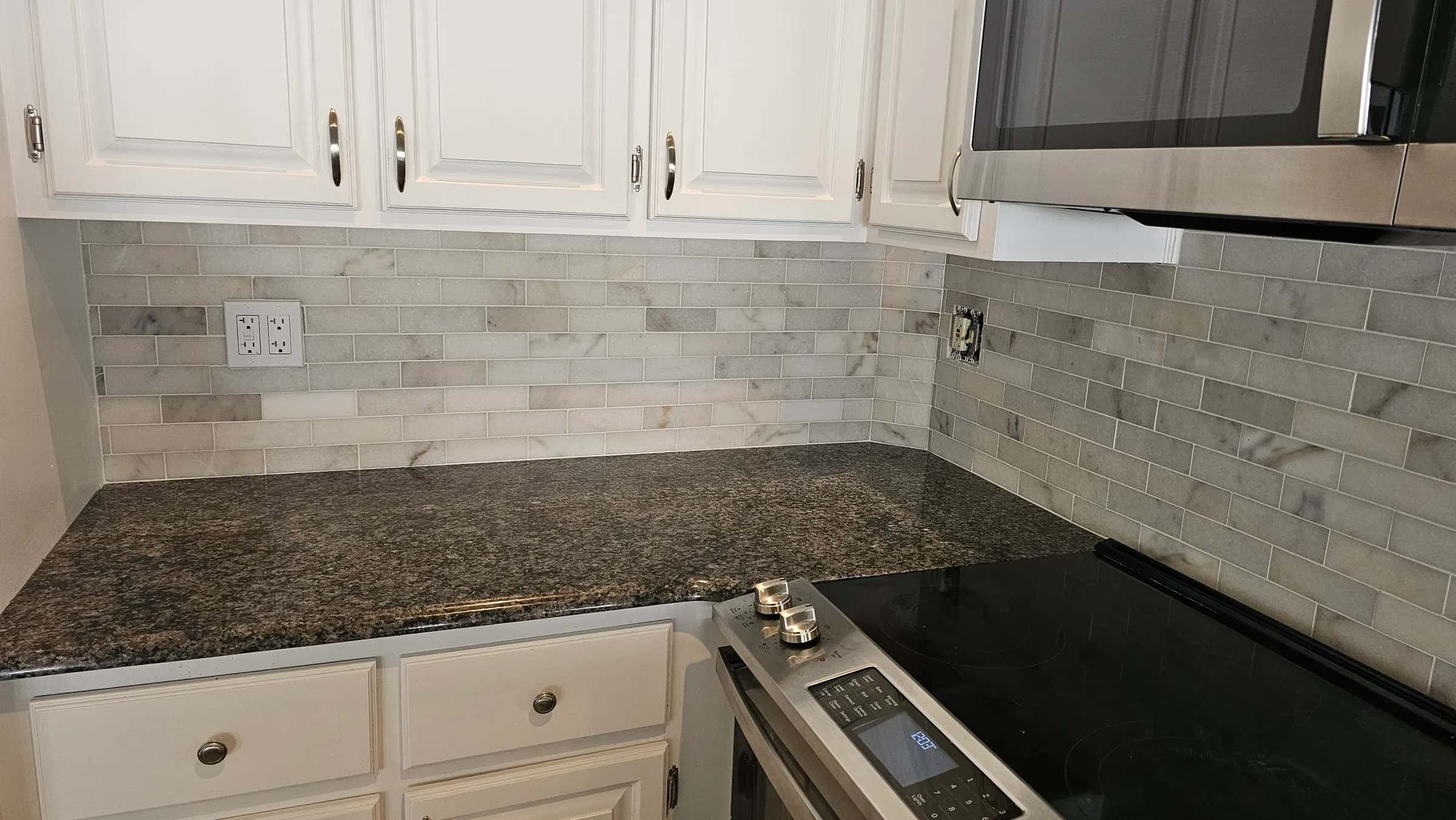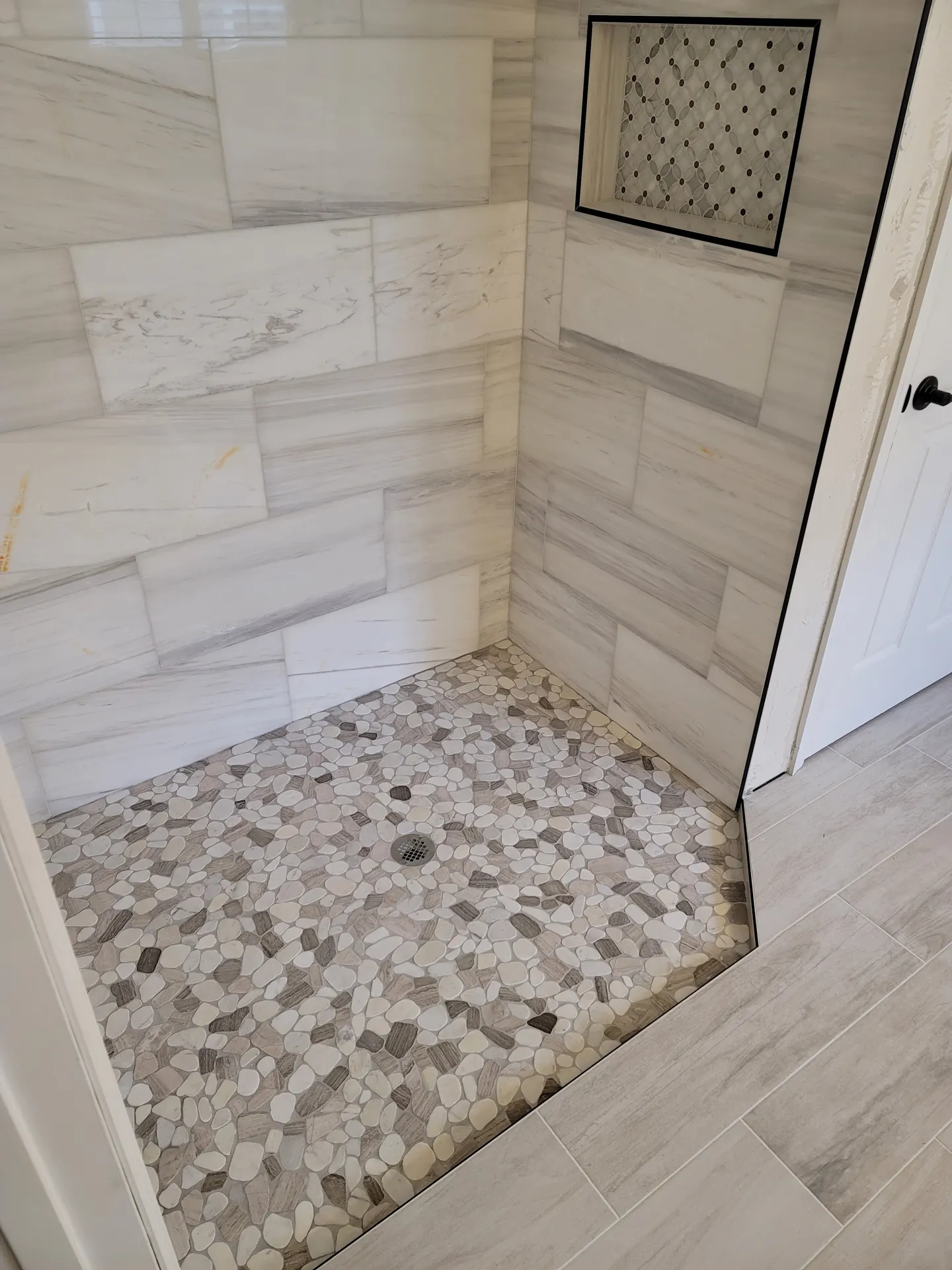
Custom Shower Tile Installation in Orlando: The Hidden Work
A luxury shower is the hardest tile job in a house, and the parts that decide whether it lasts are the parts you never see once the tile goes on.
Read the article →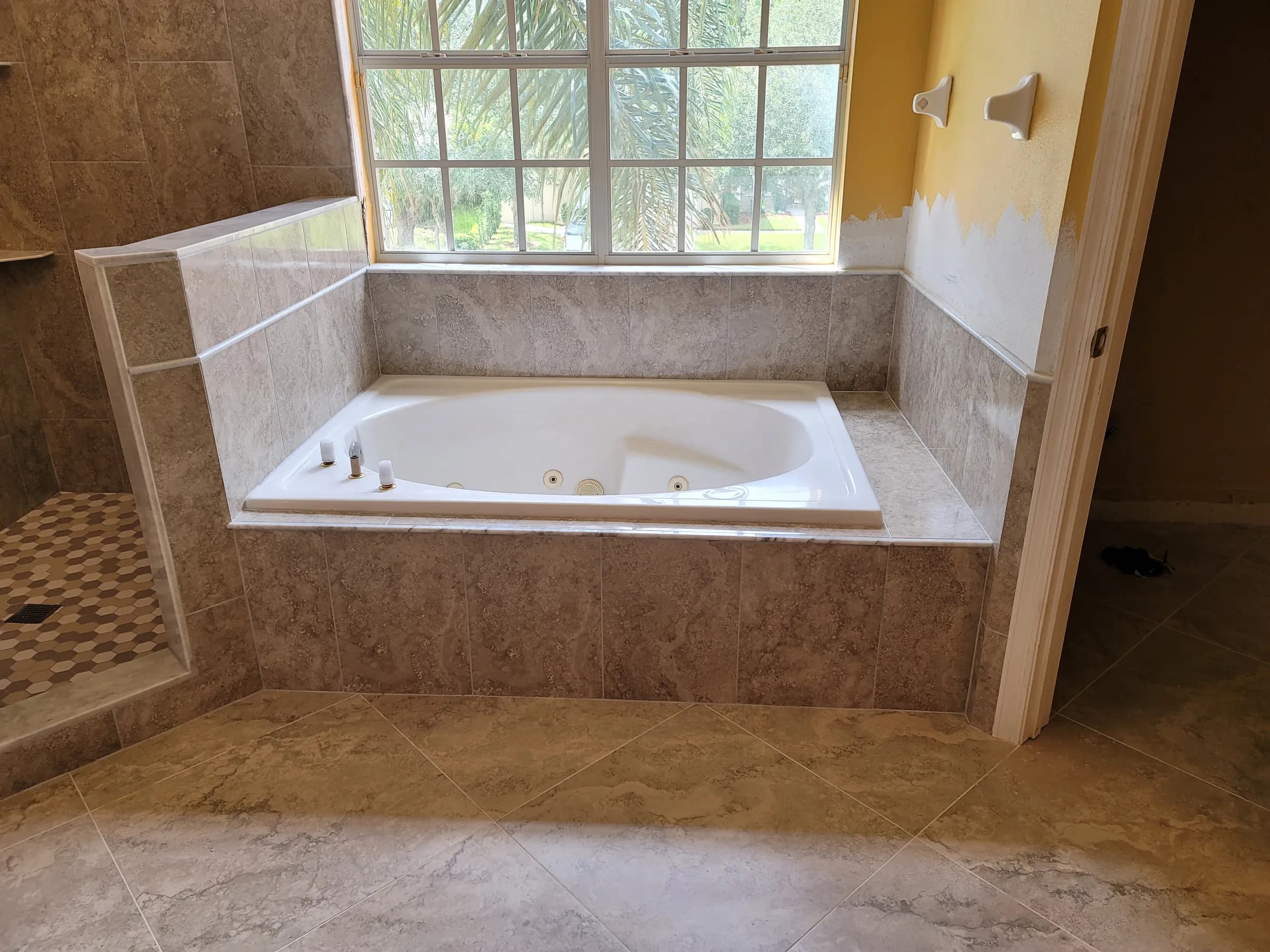
Large format tile is the one material where the look and the difficulty run in opposite directions. A great room floor in 24 by 48 inch porcelain reads as calm and almost continuous, with grout lines you have to look for. That quiet result is the hardest thing in this trade.
People see it in a model home and assume bigger tile means fewer pieces and less work. Fewer pieces, yes. Large format tile installation in Orlando is mostly about what happens before the first tile goes down.
The industry line is any tile with a side longer than 15 inches. That starts at 12 by 24, close to a default in Central Florida new construction, and runs through 24 by 48, wood-look planks at 12 by 72, and gauged porcelain panels 5 feet by 10 feet.
Weight climbs with it: a 24 by 48 porcelain tile runs 35 to 40 pounds, and a 5 by 10 panel passes 100 pounds and cracks under its own weight if it flexes.
Tile does not bend. A small tile rides over a hump because the deviation is shared across many joints. A 48 inch plank spans the hump, lands on the high point, and lifts at one end.
The standard is specific. Under tile with any side 15 inches or longer, the substrate has to be flat within 1/8 inch in 10 feet and 1/16 inch in 2 feet, and under smaller tile the allowance doubles to 1/4 inch in 10 feet. Most slabs miss the tighter number on their own.
We map the floor with a 10 foot straightedge and a laser, never a torpedo level: a 2 foot level will call a floor fine and still be off half an inch across the room. High spots get ground with a diamond cup wheel, broad low areas get self-leveling underlayment, and we check again before mortar comes out.
We never make up flatness with extra mortar. Spot bonding leaves the tile hollow in the middle and cracks it a few years later.
Lippage is the height difference between two tile edges at a joint. You feel it with a bare foot before you see it.
Large porcelain is fired with a slight crown, an allowed amount of warp that leaves the center a hair higher than the ends. Stagger two planks at 50 percent and the end of one tile meets the highest point of its neighbor, which guarantees lippage no matter who sets it.
Most manufacturers now specify no more than a 33 percent offset on tile with a side over 15 inches. A one third offset or a straight stack solves it, and we raise it at layout, since it changes how the floor reads.
Large format goes down in a mortar rated for large and heavy tile, the class once called medium bed. It holds its ridge height without slumping, so the tile stays where we set it.
We comb in straight lines, all one direction, back butter the tile with a flat skim to fill the ribs, and beat each piece in across them. Coverage is the number that matters: 80 percent mortar contact in dry areas and 95 percent in showers and wet areas, with full support at every edge and corner.
A void behind shower tile holds water and starves the bond, and an unsupported edge chips the first time something hits it.
Clip and wedge systems hold neighboring tiles in the same plane while the mortar cures, taking out the last 1/32 to 1/16 inch of difference. They cannot flatten a floor. Ask a clip to bridge a real dip and it lifts one tile off the mortar bed, leaving a void. Clips are a finishing tool. Prep is the fix.
Cutting is its own discipline here. A long rail cutter scores and snaps straight cuts, and a bridge saw or rail-mounted wet saw with a continuous rim blade handles slabs and miters. Inside corners get drilled with a core bit first, because a square inside corner is a crack waiting to happen.
Moving a panel takes a suction frame and two or three people, carried on edge and kept rigid. Break one and the replacement runs several hundred to well over a thousand dollars, plus a wait for a piece that may not match.
Tile moves, and Florida floors take direct sun through big sliders. Soft movement joints belong at the perimeter of every tiled field and in the field itself: roughly every 20 to 25 feet indoors, and every 8 to 12 feet where sun hits the floor. Slab control joints get carried through the tile or handled with a crack isolation membrane.
At the walls we leave about 1/4 inch, sealed or left open, and the baseboard covers it. Grout tight to the wall and the floor relieves the pressure by tenting or cracking.
People ask for a 1/16 inch joint because it makes a floor look like one surface. On most large tile it is not realistic: every tile carries a small allowed variation in size and warp, and the joint absorbs it. Squeeze the joint down and the variation shows up as lippage instead.
The working range is 1/8 inch on most rectified large format, 3/16 inch on long planks or anything with visible bow. Match the grout color closely and the joints recede anyway.
Large format earns its keep in open great rooms with long sight lines, on shower walls where a panel runs floor to ceiling with almost no cuts, on fireplace surrounds, and on waterfall island ends. Our gallery shows how that scale reads in a finished space.
It works against you in a small busy bathroom where every fixture becomes a cut, and on a sloped shower pan: a pan drains in several planes at once and rigid 24 inch tile cannot follow compound slope. That is what 2 inch mosaic is for. It also fights floors full of transitions and angled walls.
Ballpark labor ranges for the Orlando area, not quotes:
Labor runs above standard tile per square foot even though there are fewer pieces, because the hours go into flattening the substrate, laying out the offset, back buttering, and moving heavy material without breaking it. Our post on custom tile installation cost in Orlando covers the other variables. Every job is quoted individually after we walk the space, free.
We come out, put a straightedge on your floor, and tell you what it will take to make it flat enough for the tile you picked. Sometimes that is an hour of grinding, sometimes a pour across the whole first floor. You deserve to hear that before you buy the tile, and the rest of what we install is on our services page.
We are a family-owned company with more than 20 years of tile work in Central Florida, licensed and insured, working in homes across Windermere, Winter Park, Lake Nona, and Horizon West. If you are planning a large format floor or a slab shower, call us at 407-538-1155 or use our contact page and we will look at the space free.
Large format means any tile with at least one side longer than 15 inches. That covers common sizes like 12x24, 24x24, and 24x48, long wood-look planks, and gauged porcelain panels that reach 5 feet by 10 feet. The bigger the piece, the tighter the flatness and layout requirements get.
Roughly 1/8 inch in 10 feet, and 1/16 inch in 2 feet, for tile with any side 15 inches or longer. Smaller tile is allowed twice that deviation at 1/4 inch in 10 feet. Most Orlando slabs need grinding, patching, or self-leveling underlayment to reach the tighter number.
A 1/16 inch joint is not realistic on most large tile, because the joint is what absorbs normal variation in size and warp between pieces. We generally set 1/8 inch on rectified large format and 3/16 inch on long planks or tile with visible bow. Matching the grout color to the tile hides the joints far better than squeezing them tighter.
Yes, per square foot, even though there are fewer pieces to set. Ballpark labor runs about $9 to $16 per square foot for large format floors, plus substrate prep, with gauged porcelain panels considerably higher because of the handling and cutting involved. We quote every job individually after seeing the space, free of charge.

Luong Tile is a family-owned tile and flooring company serving Orlando and Central Florida for over 20 years. Licensed and insured. Call 407-538-1155 for a free estimate.
Keep Reading
A luxury shower is the hardest tile job in a house, and the parts that decide whether it lasts are the parts you never see once the tile goes on.
Read the article →Three bids, thousands of dollars apart, same room and same tile. Here is how to read them, what to ask every installer, and when the low bid is actually fine.
Read the article →Herringbone, chevron, basketweave, hexagon mosaics: which patterns earn their price, why the labor costs more, and how to vet an installer before you commit.
Read the article →